
• Passages: Joshua 20-21, Acts 1, Jeremiah 8, Matthew 24,

    Not one word of all the good promises that the LORD had made to the house of Israel had failed; all came to pass.
    Joshua 21:45

    When we speak of the promises of God, we’re talking about things that will happen, at least that’s the way we Christians see it. When God tells us that something will come to pass, it will. The problem is that most seem to then comb through the Bible looking at the promises of God hoping to foretell the future. After all, God doesn’t want believers unaware, does He? He would tell us such things for a reason, wouldn’t He?
    The passages for today cover some of the richest of these “apocalypse” texts. But here you’ll find little reason to sell your things, buy canned goods, build a bomb shelter and wait for Armageddon. Instead, the promises here are told for a reason that I fear most western Christians will invariably misunderstand. These things are written so that the people who read them might be strengthened to persevere through what is to come.
    For example, take the Matthew 24 passage. It does go into some pretty harsh predictions for the future, including a massive amount of tribulation, but don’t miss the context for the statements. The disciples had asked when the buildings will be thrown down (referring to the temple) and what will be the signs of Jesus’ coming. Jesus answers in such a way as to make sure that his disciples are not deceived (v. 4). He then gives them warnings as to how lawlessness will come to pass, and how people will claim to be Jesus. There will be natural disasters and many people will die, but that will not be the end.
    Now, many can start to catalogue the events and try to correlate them with CNN Interactive, but that would be missing the point. Jesus is not telling us that we should spend our time reading signs to determine the end, but rather that we should read the signs so that we will be strengthened to carry on, rather than weakened by the opposition. That we should continue to spread the Gospel, as when that is finished as a testimony to all the nations (v.14). All of these apparently negative things we see and face are within God’s plan.
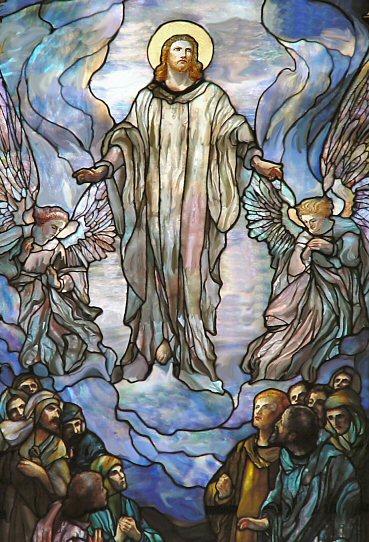
    This is echoed in the first part of Acts 1, where we see Jesus telling the disciples that they are to be his witnesses to the ends of the earth. (which he says in response to the question of when he will bring about his kingdom). Again, we are to look to the end, to the establishment of the kingdom of God and the return of King Jesus, but it is not a passive wait, we are heralds of the coming kingdom. The message of the warnings and prophecies are to embolden us to be faithful to Christ, and to carry out what he calls us to, not simply to discern the signs and so avoid pain and trouble for ourselves.
    May we be so empowered by the promises of God, that we live for Him despite afflictions, indeed, may we see affliction as a part of Jesus’ promise coming to pass, and thus a seal on the rest of the promises he made to those who trust in Him, to His eternal Glory!

    cosmos_ascension.jpg

  • Catholicism: Albert Mohler is not offended by the Pope’s recent comments.

    Calvinists: Mark Dever opines why there are so many Calvinists about these days (he’s on reason 4 of 10)

    Environmentalism: Tim Challies (who also does an awesome a la carte post each day like this one) explains how he thinks of environmentalism

    Coffee: In a blow to it’s presence almost everywhere, Starbucks now seems to be forbidden in the Forbidden City

  • 006low-15041784.jpg

    Sometimes a blog seems to me a study in hubris. After all, there has to be some overarching pride involved to actually spend time writing my comments in a public place for all to see.

    There also may be some insanity.

    After all, I have no idea if anyone will be interested in reading my take on things, so until I build an audience (a questionable eventuality at best, considering the poor update schedule I maintained at my old blog, also of this name), I am talking to myself. I’m like one of those people you see on the streets of big cities in dirty clothes muttering to themselves. Often times saying things that either make no sense, or are more offensive than their smell when they sit next to you.

    So in essence, I’m volunteering to be the local crazy (though I promise to keep showering daily).

    The thing is that this is also the role performed by actual prophets. No, I don’t mean those loopy end-times prophecy people, or even the political mavens crowding the left and the right at the moment (who are all backed by some form of major media). No, a real prophet generally comes in under the radar, and looks crazy.

    Like the prophet Jeremiah. Much of the time he was speaking doom and gloom messages from God, though to people around him, he must have seemed a bit of a nut. Maybe that’s why people didn’t like him much.

    The problem was that he was right. He was simply speaking the truth as he heard God give it to him. Did anybody hear? Sure, but that wasn’t why he spoke. He spoke because the LORD told him to, and that is the same as for any Christian. Jesus said that we will be his witnesses in Jerusalem, In Judea and Samaria, and to the ends of the earth. So we have heard from God a specific call to speak the truth we have heard; woe be it to us if we do NOT speak.

    So let it begin, I shall try to speak the truth as I hear it from God through His word. I welcome comments, as well as rebuke for the pride of thinking I may speak something that God says…. though unlike Jeremiah, I’m gonna cheat. I plan to blog what I hear said through Scripture (things God’s already said).

    If anybody wants to follow the Bible passages I’m reading as I go along, I’m reading the M’Cheyne plan. (it can be found here)
  • I am generally a fan of facebook. I use it almost every day, and have a plethora of information on it. It’s also been a boon to me while I work here in the North, keeping me in contact with friends and family.

    There is a problem though. The first years of university marked a profound change in my life. While I had been a “churchy” person previously, I had believed in no real god other than my own conscience (indeed, I was communist in all that entails, including amistrust of religion), so when I came to faith in jesus Christ, there was a lot of reworking of my life and thoughts. I can honestly say that in many ways, I am not the person I was in high school, though I may physically resemble that guy.

    So this leaves me in a difficult predicament when it comes to facebook. Iam now beginning to meet people I knew in High School. Few of them were really friends, as I honestly was an odd person back then. That said, I get a message every once in a while asking me to add someone who I really didn’t like in High School, and who probably knows me as that socially awkward guy (okay, more socially awkward than I am now). Yet I believe that all things work together for the good of those who love and serve the Lord and are called according to His purposes.

    So why did God not save me in High School, where I could have developed less dysfunctional ideas of these people, and even more important, what is God doing in (and with) my life now to use the person He’s made me with people who knew me then? what am I to do with the people who rememer the old man, when there’s a new man putting that guy to death?

  • holy-cross-goc.jpg
    I think people seriously misunderstand what salvation is.

    I was talking about this before, where God saves us from high interest rates, and the necessity of going to the doctor for the ingrown toenail rather than saving us from sin. But then, that’s only part of the situation.

    The central problem we humans have is that we seriously misunderstand the nature of the universe. Any of us with half a brain and the ability to look at the universe realize pretty quickly that the universe is not about us. That’s a correct understanding. Many of us leave it at that because, well, we can’t get over ourselves. Like that guy in “About a Boy”, we see our lives as TV shows about us. When faced with the realization that self centered life is hollow, we find ourselves focussing on “society” or on “stuff” or anything to hopefully keep us believing that there is some meaning. It’s what Kierkegaard calls “despair”. Smart guy, Kierkegaard.

    This stuff can only keep us so far, though, as when we look into the cosmos, and the vast expanses of interstellar pace, and the shortness of our own period of life here on this tiny ball, we learn that our short life spans are insignificant in the grand scheme of both time and space, and that there was a time with no life, and given the freakish improbability of life, there will probably be none when the sun finally gives out and we cease to be even as a race.

    Most people give up here. They either invest all their time in convincing themselves that humanity matters, contrary to all the evidence, or simply give up and become those horribly depressing people who dress in black at coffee shops.

    Indeed, those are the rational choices, based on the evidence I’ve given so far.

    But then, there’s Jesus.

    Contrary to some movies by the more loopy skeptic set, Jesus was a person who actually existed. Who actually taught during a historical period that is identifiable, and was falsifiable. A man who was crucified on a cross, and then, if the story is true, rose from the dead on the third day.

    Many here say “but that’s impossible”, and I agree, if the premise is that the universe is as we’ve believed it to be. But then, that is probably a point of the resurrection. It’s impossible, unless we’re wrong.

    And see, we’re wrong.

    Jesus came into a place and time that told a story. That story is that the universe is indeed not about us, as the evidence suggests; that things have a point, as the evidence of our own hearts suggests, and our very desire to see a “point” in things suggests. Yet the point is not us. The point is a loving, powerful and just God. One great enough to create a universe, and good enough to create love. This God actually fits the evidence.

    And the resurrection creates the dissonance to show that we are wrong, and the God that is the point is really there. A God who resurrected Jesus to validate what Jesus told us about a grander purpose; one where we are created….. created to love God….. and separated from God by a desire to BE God, to BE the point in the universe.

    When we decided to BE the point, we live a lie, and we all know it’s a lie. We need a saviour, not from worthlessness, not from despair or immorality (those all those come from it), we need a savior from our sinful desire to be God, to make something that isn’t God into god.

    We need a savior from us.

    And into that story, that context, that grand sweep told through thousands of years of history in a single people in the middle east steps Jesus.

    The Saviour.

    He said “come unto me, all that labour (even labour to avoid despair) and are heavy laden (even with the realization that they are not central to the universe), and I will refresh you”.

    He also said that those who see him, see the father, the real point of the universe.

    He offers the real salvation, not a mediocre call to get rich and have 2.2 kids, but communion with a real God, that is infinitely worthy, who is the point, and who offers us the ability to enjoy him forever.

    There is a saviour, He is Jesus.

    So call on Him to save you.