
• So, today I was rolling pennies (ah the joys of working retail), and watching a Gill Deacon rerun on the CBC (Yay, Public Broadcasting). This episode seemed to be focussed on the relationship thing, and despite the fact I wrote a bit on  it recently, I figured I should react openly to it (though now people may rightly call me “obsessed”)Probably the most objectionable part I found was the segment on the dating service for people already married (yes, you’re reading that correctly, a site dedicated to empowering philandering), called Ashley Madison. I feel bad giving the link there…

    But when the interviewer asked its creator about the reason for the morality of it, he simply started to talk about feeling “unfulfilled” in marriage. Now, I’m not married, but I can guarantee that in any earthly relationship, at some point you’re going to feel unfulfilled because both members of any relationship besides the one with God are sinners.

    The second segment, I believe, was a little more enlightening. It was about the Canadian documentary, lovable, which consists of interviews of several people who remain single/never marrieds in their 30s, 40s and 50s. It chronicles the sense of loss, and in some cases failure of being single at these ages and not wanting to be.

    What was interesting to me was that the director seemed to hit the nail on the head when he alluded to the need for romance in relationships. He pointed out that there were often other things at play in most instances of romantic love, that can lead older singles to discount great people from the dating circle because they don’t give you the hormone charged high that you got in your teens and 20s. It’s an unrealistic high (that if you keep, will probably have you on Ashley Madison 10 years after successfully marrying).

    To put it in religious terms, one of the most prevalent idols in modern times (and especially in my own life) seems to be the desire for romance rather than love and family. Romance is good and noble in its proper place, but it is not going to fulfill you (that’s Jesus’ job), and it isn’t even the center of a good marriage (Jesus is that too).

    This is not to say that I don’t seek romance. Quite the opposite, I am even using online dating services like Plenty of Fish (free, but I don’t recommend it, there are a lot of nuts there….. like bloggers who talk to themselves in public), Christian Cafe (pay service that at least limits to self-described Christians, if you ever join it, send me a message, it’ll make me feel less like I’ve wasted my money), and eharmony (the cadillac of singles sites, but too rich for my blood beyond the trial period).

    But in the end, as a single in my 30s (33 in 2 weeks), who desires a family greatly, it’s clear that Christ has to be the center, or I’ll end up following the world in placing too much on my wife and kids if God ever blesses me with them. It’s a hard struggle, but a necessary one, as no false gods will fill the role only the one true God can. In the end they are worthless in comparison to Him.

  • Truth (and epistemology): Dr. Russ Moore asks an important question of postmodern emergent, based on his earlier conversation with Tony Jones of Emergent Village.

    Harry Potter: Seems some of the leaks of the Harry Potter ending are genuine.

    Theology: Albert Mohler may have an example of what I termed loose thinking

    Review: Tim Challies reviews “Jesus the Evangelist”, a new book by Richard Phillips

  • graphicearlymorning.jpg

    Every once in a while, often without warning, I can be struck with the beauty of things around me. One of those experiences struck me today, and caused me to think immediately of a book I heard reviewed recently. It was called “Better Never to Have Been: The Harm of Coming into Existance“. I’ve never read the book (and doubt I ever will), but apparently the book’s thesis is that it is better to have never been born, and that it would be best for humanity to extinguish itself.

    That thesis runs in complete opposition to my own experience. Now, to say that hauling freight from a coastal boat to my brother’s warehouse complex is a positive experience would simply be a lie. Myself, I was warm, stressed, and my muscles ached, yet for a moment I looked off into the lush green of the forest surrounding Nain, and just thought, “How beautiful”, and for a moment I worshipped God there in the truck. It was a moment that someone like Tony Campolo would say was a moment where I was “truly alive”.

    Now I think there’s a clear lesson there, one that several Christian thinkers have mentioned. Life for humans is most fulfilled, not by love or acceptance, but primarilly by worship. As Ravi Zacharias said in a recently broadcasted podcast (info about the podcast can be found here), meaning is ultimately found in the act of worship. This is seemingly an echo of what we see in the Psalms (just give this passage a think, It’s Psalm 100, ESV)

    Make a joyful noise to the LORD, all the earth!

    Serve the LORD with gladness!
    Come into his presence with singing!

    Know that the LORD, he is God! It is he who made us, and we are his; we are his people, and the sheep of his pasture.

    Enter his gates with thanksgiving,
    and his courts with praise!
    Give thanks to him; bless his name!

    For the LORD is good;
    his steadfast love endures forever,
    and his faithfulness to all generations.

    The thing I notice most clearly about this passage is that it only has an implied audience, but that it focuses entirely on God. There is no sense in which it affirms the worshipper, or even says anything about the worshipper (save to further expand on God’s greatness), it focuses on God. The basis for the joy here is not personal affirmation or self esteem, but an overarching God-esteem, and a focus on God.

    John Piper once pointed out that to ask a man in heaven if he is humble would come across as simple nonsense to the man, because he would be so enamoured of God, talking of himself would seem strange.

    Each of these things points to something I believe our society has forgotten. In our elimination of God from the equation, we have raised ourselves to the level of existential foundation; the reason we exist is for ourselves. The result is that life becomes meaningless, because human life was never meant to be the basis of meaning (despite anything Ayn Rand would’ve said). And the children of such thought patterns are left believing they are better to have never been. The tragedy of it is that they believe it because they have never truly lived.

    Salvation cannot be centrally about affirming who we are in God’s kingdom. That is a derivative, but necessary step to the real goal, and where we will truly find life. Salvation is ultimately about affirming who God is, because it is God that is truly valuable.

    Jesus tells us to come to him that we may live and have life more abundantly. He wasn’t kidding. Our shortfall is that we’ve never quite believed Him on that one. Oh I pray that we might be convinced for more than a moment! I hope you will join me in that prayer.
  • Law: A British tribunal makes a slightly troubling decision.

    Conscience: West Point grad becomes Christian, asks for discharge.

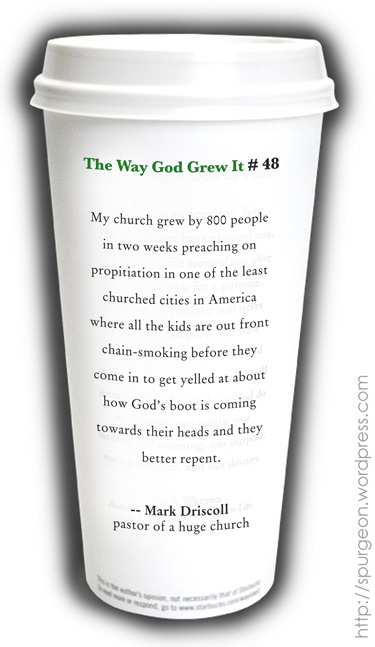
    Marriage: Part 10 of “Death by Ministry”, Mark Driscoll talks about blessing the pastor’s wife.

    Baptism: Thabiti Anyabwile talks about the”heart” the credo/paedo baptism debate