• Pursuing Holiness

    My local Church has decided to make the focus this year the pursuit of holiness. Now, as someone who has been around church circles, when we first talked about the idea, I have to admit I had a slight lurch in my stomach. Holiness? Does that mean we’re going to be going around like Saudi Arabia’s Mutaween, making sure that people who go to our church always do the right things according to the Bible? Am I going to be measuring skirts to make sure they’re not an unacceptable amount above the knee, and reporting when I see people going into the liquor store or (gasp) a movie?

    You see, these methods have been historically the way some of our more holiness-inspired brothers have sought to make the church “holy” in its conduct. When people have a standard of behaviour, the (apparently) natural outworking is to see how many others are adhering to that standard. If we are called to live holy lives, then I should make sure that my next door neighbour adheres well to those standards, even moreso if they are fellow believers and may be straying from the godly path by going to see the latest animated musical in theatres.
    The impetus isn’t limited to churches either. Irate fellow tenants often castigate their neighbours for not recycling properly (or at all), and there are the judgemental stares that follow families with a lot of children around. When we’re given a standard, our natural inclination is to get others to follow it.

    It gets so bad that many will simply deny the need or existance of standards. From churches that refuse to talk about (rather obvious) evils, to the more extremist libertarians and anarchists who seem to be want to be rid of any government at all.

    Yet God has said that holiness is a good thing, a necessary thing. God Himself points out that holiness is one of his attributes (Ex 15:11), He tells us to worship Him in holiness, and even calls that holiness a splendour (Ps 29:2). We are called to control our bodies in holiness (1 Th 4:4). We’re even warned that without holiness, none of us will see the Lord (Heb. 12:14).

    So what are we to do? Should we be installing trackers in people, and grading behaviours, dress, and language?

    Probably not. First of all, there is the frequently misused warning Jesus gave us in Matthew 7 to not judge others in any way you are not willing to judge yourself. This doesn’t mean we all should avoid judging entirely, but that any judgement is first to be levelled at yourself.

    But the more important reason is that the holiness God desires, and that the Christian pursues is not primarily a function of behaviour, but of faith. This is not to say that the behaviour is unrelated, and that we shouldn’t be troubled by the sin we see in ourselves (indeed, we are called to repent of any sin we see in ourselves), but rather that it is a fools errand to go around fixing external behaviours when the real problem is that we have hearts far from God. The sin is bad, what is worse is that we sin because we want to, and that sin of willful rebellion to God is far worse than the symptomatic instances of bad behaviour we can control with rules and social isolation.

    Holiness isn’t something you create by force of will, but something you put on in the grace of Christ by faith in Him. Ephesians 4 is instructive:

    “Now this I say and testify in the Lord, that you must no longer walk as the Gentiles do, in the futility of their minds. They are darkened in their understanding, alienated from the life of God because of the ignorance that is in them, due to their hardness of heart. They have become callous and have given themselves up to sensuality, greedy to practice every kind of impurity. But that is not the way you learned Christ!— assuming that you have heard about him and were taught in him, as the truth is in Jesus, to put off your old self, which belongs to your former manner of life and is corrupt through deceitful desires, and to be renewed in the spirit of your minds, and to put on the new self, created after the likeness of God in true righteousness and holiness.”


    The Holy Bible: English Standard Version (Wheaton: Standard Bible Society, 2016), Eph 4:17–24.

    Notice a couple of things. While Paul (the writer of Ephesians) does actually expect his hearers to act in ways that are in keeping with Christ, his call is not to make them act better, but rather to “put off” the old self and to “put on” the new self that is “created after the likeness of God in true righteousness and holiness”. What’s the difference between essentially pretending to be holy until you actually are, and this “putting off and putting on”? Paul gives us a rather direct hint when he says that those who are acting in unholy ways are in the “futility of their minds” and in an ignorance born of their “hardness of heart”.

    Instead of being a moral reformation method, the holiness that is expected of Christians, and provided in Christ is instead a transformation from one type of person to another. From a person that is self-made in sin, to one that has been made by God through faith in Jesus Christ.

    Thus true holiness is found, not primarily in avoiding sinful actions (or even actions perceived as sinful), but rather in forsaking your own hard heart and having God remake you into the likeness of God. It is a transformation of the heart before it is a reformation of the morals.

    Thus as I embark on the year of pursuing holiness, I am not beginning a year where I call myself and others just to better action, but where I daily point myself to Christ, and cast myself on His grace and mercy, trusting Him to change me, and calling those around me to do the same.

    SDG

  • Technerdiness: Apparently some people have turned to body modification to keep apple airpods in their ears.

    Grieving: Remember that Christmas can actually be a harder time for some. Desiring God gives some thoughts as we pray for friends and family that may be grieving in a time of great joy.

    Politics: Some think the religious right is monolithic. Even in a year that saw evangelicals overwhelmingly rally around a candidate, get religion points to a story of deep division among evangelicals over president Donald Trump.

    Charity: As we think about giving this Christmas season, remember that loving our fellows can mean thinking about needs that don’t necessarily tug at our heart strings as much, CBC reports.

  • Nativity Quiz: How well do you know the Nativity story in the Bible? Take this quiz to find out.

    Reporting Putin: How can we interpret support for Putin in the west as something other than “extremism”?
    Canon Dating: (no, not having coffee with artillery) Michael Kruger argues for an early understanding of a NT scriptural canon.

    Marriage Check Up: Kevin DeYoung advises married couples to do a bit of year-end examination of their marriages, and gives some questions to get you started.

  • I know it’s strange to say this: but I really don’t like how some people are nice to me in traffic. It isn’t everything nice that people do, but today when I was trying to turn left from a busy street into a bookstore parking lot in the city I live in, someone on the inside lane decided they’d be nice and stopped to let me out. The problem? He didn’t seem to notice the string of traffic coming up beside him on the other side at full speed, and had I not been looking behind his remarkable over-large truck, I wouldn’t have seen them. Had I turned just then, trusting in the goodwill of the person being nice, I’d have had a very bad day (though I guess, given the speed of some of those other cars, I might have gotten to see Jesus today).

    My mom would have said that he had his heart in the right place, meaning that it was good that the man showed me compassion in my (very light) need. Unfortunately, I’m not so sure that’s true. In fact, I’m relatively sure his heart was in precisely the wrong place. Namely, I think that his heart was doing the job his head should have been doing, and were I to rely on his kindness, it would have been to my detriment.

    This seems to be a more general problem than among drivers in St. John’s, Newfoundland. I think this is the reason that so many of us Christians try to do nice things that end up doing more harm than good. Of course, we have compassion, and compassion is a good thing, but only when it translates into actions really aimed at the other person’s good, and given the human mind’s habit for self-deception (see Jeremiah 17:9), this has to be examined carefully.

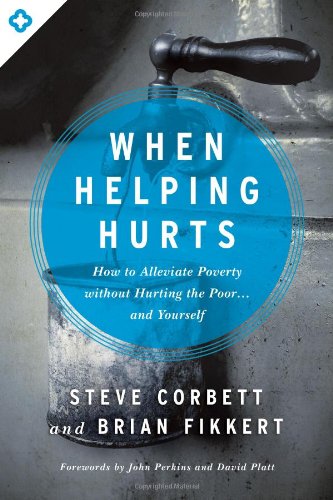
    For example, how often do we end up being like an example in the book “When Helping Hurts”,

    514-e1yyuol
    A really good book on the topic. The authors walk the reader through the ways in which we can think we’re helping when really we’re hurting both the recipient and ourselves.

    and give people gifts that help immediately, but end up deriding the people we show the charity to, and create a culture of dependence in the person we do nice things for? How often do we end up giving the single mom’s kids gifts in a way that makes the kids thank us, but learn that their mom can’t provide, and they should be looking to other people for provision? Or expect the single mom to be suitably grateful instead of helping because we care for them?


    When I help people, I need to be careful that I’m actually helping instead of just getting rid of my bad feelings. I need to
    be careful that my help doesn’t end in a wreck for other people, even as I end up feeling better about myself. The simple fact is that facile help doesn’t always help, and sometimes we need to think deeply about people in order to properly help them. It may mean we need to get closer. It may mean we need to learn some uncomfortable truths about our society and the way it treats people, it may even mean that we look like terrible people for a time in order that we provide real lasting help to people.

    Quite simply while we must have compassion for those around us, our compassion must be guided by wisdom and knowledge.

    Our hearts must be in the right place: guided by our heads.

  • glory to christ centre header 2In my last post, I talked about how I now believe that Paul’s view of the Christian mind, as shown in Romans 12:1-3 is a fundamental alteration in the way a Christian processes their world and their place in it. It isn’t simply that we exchange a “worldly” set of opinions for a “Christian” one.From this, there’s a raft of interesting (and slightly controversial) implications for thinking this way. I’m going to deal with one of those today.When I was much younger, I had an image of Christian evangelism that could most easily be likened to the Church as a fortified camp which, from time to time, sent out raiding parties into the world to bring people into the camp to become Christians like us. Of course, this is a fairly pejorative image, and coming from how I understand the Christian walk now, it’s flatly unhelpful. It comes from the idea that the difference between Christians and the non-Christian is merely a surface set of opinions, and if we take them from the world made up of worldly surface opinions, and indoctrinate them into Christian surface opinions, they will suddenly be Christians.

    When I was much younger, I had an image of Christian evangelism that could most easily be likened to the Church as a fortified camp which, from time to time, sent out raiding parties into the world to bring people into the camp to become Christians like us. Of course, this is a fairly pejorative image, and coming from how I understand the Christian walk now, it’s flatly unhelpful. It comes from the idea that the difference between Christians and the non-Christian is merely a surface set of opinions, and if we take them from the world made up of worldly surface opinions, and indoctrinate them into Christian surface opinions, they will become Christians.

    Yet, if the change that comes from conversion is what I think it is, a fundamental alteration of a person’s central heart-paradigm, this method of evangelism is not only unhelpful, it may actually be damaging. It would be convincing people that they are saved from sin when all they have been saved from is a set of incorrect opinions. Indeed, it can even result in entire churches for whom their central object of worship is their own doctrinal correctness instead of the Glory of God revealed in Jesus Christ. We can end up defining “Christian” as “person who agrees with Christian opinions” instead of “person who desires to be like Christ”. The former can be created through indoctrination, the latter requires an act of God to change the heart.

    But if this is true, there is a very sobering conclusion to be drawn. I can affirm every point of the creeds and catechisms of the Church, and even memorize large chunks of scripture, but be as utterly lost as the most egregious sinner I can imagine. The question of whether one is a Christian is not whether we agree with a creed (though as I will talk about later, creeds are great diagnostic tools), but whether we have had the kind of change in ultimate goals. Are we desiring to be transformed into the very image of Christ?

    So what does this mean for evangelism? It changes our goal. This can be encouraging for some, and discouraging for others since the goal is not to convince people that they should make a profession, read their Bible, or start coming to Church (though those things will all be effects of real evangelism). No, the goal is to glorify Jesus Christ as beautiful, and then live in close community with those who see His beauty.

    To change my opening image then, we are not called to make raiding parties into the world, but instead, show the all-surpassing value of Christ.