• So my new year’s resolution is to have some discipline in the new year. It’s not that I completely lacked discipline before, but that I always see the need to improve in that department. The weird part is that developing discipline is not quite a thing in itself as much as it is seeking to change your habits form bad ones to good ones. You don’t gain discipline by seeking to develop discipline in the abstract, but by more directly seeking the things you should (and as a result ignoring the things you shouldn’t).

    The Christian life is, in the end, not so much about primarily avoiding things, but seeking after things; primarily seeking after the God who is the proper object of our affections, but also concretely seeking the things that mark such an ultimate pursuit. As Paul says in his letter to the Philippians:

    Rejoice in the Lord always; again I will say, rejoice. Let your reasonableness be known to everyone. The Lord is at hand; do not be anxious about anything, sbut in everything by prayer and supplication with thanksgiving let your requests be made known to God. And the peace of God, vwhich surpasses all understanding, will guard your hearts and your minds in Christ Jesus.
    Finally, brothers, whatever is true, whatever is honorable, whatever is just, whatever is pure, whatever is lovely, whatever is commendable, if there is any excellence, if there is anything worthy of praise, think about these things. What you have learned and received and heard and seen in me—practice these things, and the God of peace will be with you (Philippians 4:4-9, ESV)

    Notice that Paul doesn’t leave his hearers seeking to *not* do something primarily, but to avoid the evil by seeking the good. You don’t become a lover of truth by hating lies (or false news, or whatever you call it), but by seeking truth. You gain joy by thinking on worthy things, you become a man of prayer by seeking communication with God, you avoid sin by seeking to be holy etc.

    This year, I’m trying (yet again) to become a regular blogger. I am not sure it will work out, but I think my failures in the past can be informed by some of my recent successes in discipline. I have found myself more able to spend time in the Word, and in prayer, not by seeking to be a man of prayer and the Word, but by keeping love in mind, and acting accordingly. That’s how I power the long obedience in one direction that is discipline.

    The prayer list program was helpful, but what drove me to my knees more regularly was the memory that I loved the people I was praying for, and I loved the God I was communicating with (and I realized that love was as much long-term action as it was gushy feelings). I found it easier to keep to my Bible reading schedule because I wanted to hear from the God I love. The discipline came as I held that before me and acting accordingly.

    Hence the renewed interest in blogging. I am commanded to tell of the glories of God, and to reflect on His goodness in my life, living as Paul did, an example of godliness (not perfection). So here I am aiming to reflect on how God is teaching me, and share it with you, my readers.

    I have no idea if this will bring me the discipline (and the ultimate joy) of daily blogging. Telling of how God is working all things together for my good mediately, and His glory ultimately. But that is the goal.

    One year from now, lets see how it went.

    Keep me in coffee

    The author is often highly caffeinated. Keep him that way!

    C$2.00

  • Then Shaphan the secretary told the king, “Hilkiah the priest has given me a book.” And Shaphan read from it before the king. And when the king heard the words of the Law, he tore his clothes.
    ( 2 Ch 34:18–19 ESV)

    From a modern perspective, king Josiah’s response in 2 Chronicles seems difficult to understand. After all, the book of the law had been discovered as a result of a massive campaign to rebuild the temple, and move the nation away from its apostate worship of false gods. Wasn’t Josiah already doing the right thing? Wasn’t the nation already moving in the right direction? Hadn’t the government found a correct footing, and wasn’t the worship of the one true God already ascendant again?

    In this context, Josiah learns the law of God, and how much the people of Israel had failed to obey God for generations. As we read the context, it seems clear that he is correct in thinking that God would rightly punish Israel for its disobedience and apostasy. Yet this seems puzzling at some level as I read.

    I can think of a few reasons for this:

    1) I misunderstand because I think I’m owed forgiveness. I find it difficult to understand why God would punish even after people seem to have admitted their wrongdoing and moved to make things right. Yet is this really so hard to understand? Does good work after a grievous sin change the grievous sin at all? I don’t think it does. Part of my issue here seems to be that I have so deeply ingrained the forgiving nature of God into my thinking that I have come to presume upon it. It is not so much that I think Gid is laudible because He is forgiving, but that I think he is NOT laudible if he refuses to forgive, it is as if forgiveness has become my right instead of God’s privilege.

    2) My lack of understanding comes also from my failing to see a communal side to my life. Being a 21st century Canadian, I often tacitly assume the (rather insane) idea that I am an island unto myself, and that my own righteousness or lack thereof has no effect on others, and that the fialings of others in no way reflect on me. Of course, I have no right to compel righteousness in others, but how often is the lack of righteousness in those around me part of my own unwillingness to live righteously before others, and to speak of the glories of a life abandoned to God? How is the community I live in to hear of God unless I am willing to speak of Him?

    Yet very little of my (admittedly pretty insular) life are without affect by the community I live in. I have food, electricity, heat, and security, all because of the ongoing work of others. The fortress of solitude is not so solitudinous that I lack television, internet, and radio, all produced by countless others. While they do it also for their own benefit, they are working on my behalf. I am also in a better position because, by in large, many of those around me assume at least a basic level of moral action. Few steal, and most respect the closed door on my apartment as a desire to be alone unless I let them in.

    I have come to assume that too as my right instead of the grace of God working through the consciences of the community around me. How much more have I failed to see that I am responsible directly (not merely through the machinations of government) for the wellbeing of those around me.

    3) I don’t want to understand, because it feels better to condemn than it does to repent. The very statement of this point is causing a bit of moral upset in me, because even now part of me is wanting to make this about other Christians and not me. The fact is that it is always far easier to point at others and say “you’re doing it wrong” than it does to look at myself squarely and do the hard work of thinking of how I need to change. It is far easier to stay the course and convince myself that at least I’m better than . It can even hide in my desire to criticise “Christians” or “the Church” or any other group I can abstract myself from, even as I abstractly realize I’m part of the group.

    In the end, perhaps I should be reacting like Josiah and praying God will be gracious.

    Keep me in coffee

    The author is often highly caffeinated. Keep him that way!

    C$2.00

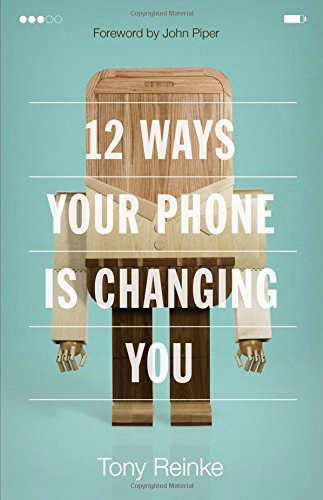
  • Tony Reinke, 12 Ways Your Phone is Changing You. (2017: Crossway)

    While it is common to find Christian books that fall short of, or meet their stated goals, It’s rare that I find one that transcends its own stated purpose. The clickbait-titled “12 Ways Your Phone is Changing You.” is one such book.

    This may be a function of my own very low expectations on beginning the book, but I was very pleasantly surprised to find that, instead of being a string of barely related pseudo-facts, the book is a tightly reasoned, astute and solidly Biblical examination of the issues raised for Christians by the now near-ubiquitous use of smartphones.

    While the book does actually match its title, and gives 12 things that happen to the Christian through their use and ownership of a phone, it does so with clear knowledge of the science, philosophy and cultural theory bearing on the subject. All of this knowledge is then brought under the direct tutelege of a consistent reading of scripture, providing a useful guide for Christians thinking through the use of mobile phones.

    All of this is to simply say that the book meets its stated goal.

    More than all of this, however, by being a biblically astute, thoughtful and honest examination of the themes of media in the smartphone age, it seems to do what Neil Postman did for media theory in his seminal work “Amusing Ourselves to Death”; it gives a model for thinking through the issues (though, spoiler alert, Reinke pointedly critique’s Postman’s views from a Christian perspective).

    It remains to be seen if Tony Reinke’s work will match the longevity and use that Postman’s work received well after its release, and after the technology it spoke of has lost its cultural pride of place (the Biblically-oriented Christian community is much more of a niche market). However, a Christian seeking to think through smartphone use, and indeed any social technology, would be well served to give this little book a thoughtful read.

    Recommended.

  • Holocaust Remembrance Day

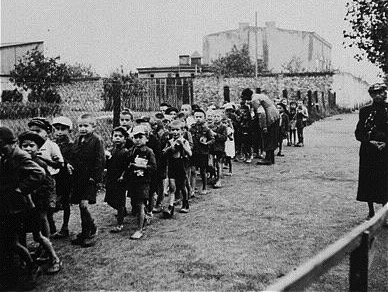
    Today, from sundown of last evening to sundown tonight, Israel and many Jewish communities around the world commemorate Yom HaShoah (Holocaust Day). The day commemorates the 6 million Jews murdered by what was, at the time, the most technologically advanced and intellectual country on earth. The victims were people like me, living a life very similar to what mine would have been at the time. More sobering, the perpetrators were also people like me, living lives very similar to mine. They were educated and cultured, and yet evil still took hold in their hearts and built truly horrific factories of death at places that now will be forever tainted by the evil done there. It’s hard to say the place names, “Auchwitz”, “Treblinka”, or “Sobibor”, without thinking about what happened there.

    By Unknown – USHMM website (www.ushmm.gov), Public Domain, Link

    I say this, because one of the scary things I find in myself is that I am able to imagine such evil is an “other people” kind of thing. Yet, a culture can turn, and make horrible things seem right (or at least not so wrong you have to stand against it), and few of us have the moral grounding and fortitude to stand against our own community if it corrupts itself. I don’t know if I do. Indeed, I find within myself a willingness to be corrupted, and I worry that many may be like me, and flattering ourselves that if such things happened here, they would stand against it. As Jesus (himself a Jew) says to the religious and morally self-righteous of his time, “Woe to you, scribes and Pharisees, hypocrites! For you build the tombs of the prophets and decorate the monuments of the righteous, saying, ‘If we had lived in the days of our fathers, we would not have taken part with them in shedding the blood of the prophets.’”. (Mt 23:29-30)

    The Holocaust reminds us that evil is not merely grotesque, it can be subtle, seductive, and even banal. People, even people we think of as decent, can become convinced of horrible ideas that lead to horrible acts. The prophet Jeremiah, in telling us to trust in the Lord reminds us that “The heart is deceitful above all things, and desperately sick; who can understand it?” (Jer. 17:9).

    Honestly, it’s hard to say much about the events themselves, without minimizing what happened (I may have said too much already). As with most events of truly staggering evil, it is best to simply let those affected speak, and the rest of us listen. This is the survivor story of John Freund, chosen from The Holocaust Survivor Memoirs Program, largely at random:

  • Culture: The National Post asks, Is it time to rethink the narrative about religion in Canada?

    Church: Gospel Coalition writes about the dangers of “Broken Wolves”

    Persecution: Christianity Today talks about the Coptic reaction to continued persecution in Egypt. I think we in the west have much to learn.